Waxing in the studio: stripless wax, wax beads, or warm wax?
Von Hassieb Kalla · Dr.Kalla RedaktionShare
Stripless wax – i.e., hard or film wax – is removed without non-woven strips and is popular in salons primarily for the underarms, bikini area, and face; warm wax, in the sense of strip wax, plays to its strengths on large areas like legs and arms. Wax beads, on the other hand, are not a distinct type of wax, but rather a form of presentation: small beads, usually made of hard or film wax, which you melt in portions in a wax heater.
To ensure you don't get confused when shopping, we have categorized the terms, compared the types of wax, and highlighted what matters regarding temperature and hygiene.
The terms clearly distinguished
- Strip wax, often called "warm wax": a soft, oil-soluble wax that is applied thinly in the direction of hair growth and removed against the direction of growth using a non-woven strip.
- Hard wax (traditional): a more viscous wax that hardens on the skin and acts as its own strip. It is removed without a non-woven strip using your fingers.
- Film wax: a hard wax with elastic components. It can be applied more thinly and remains flexible when pulled off instead of breaking.
- Wax beads: the bead form of hard or film wax. They are easy to portion because you only melt as much as you need.
Please note when purchasing: Some manufacturers and retailers – including us in some product names – also refer to low-temperature stripless wax as "warm wax." The decisive factor is therefore the addition of "stripless" or "without non-woven strips."
A comparison of the wax types
| Criterion | Strip wax | Hard wax (traditional) | Film wax |
|---|---|---|---|
| Removal | With non-woven strips | Without strips, with fingers | Without strips, with fingers |
| Layer thickness | Thin | Somewhat thicker | Thin |
| Typical zones | Legs, arms, back | Underarms, bikini area, face, coarse hair | Underarms, bikini and Brazilian, face, also larger areas |
| Procedure | Apply, press strip down, remove | Apply, let harden, remove | Apply, let harden, remove |
| Accessories | Wax heater or cartridge warmer, non-woven strips, spatula | Wax heater, spatula | Wax heater, spatula |
Which wax for which zone?
For large areas like legs or the back, many salons use strip wax because it allows large patches to be treated quickly. For underarms, the bikini area, Brazilian, and face, however, work is predominantly done using a stripless method: hard or film wax encapsulates the hairs and is pulled off without non-woven strips. Due to its thin, elastic layer, film wax is also suitable for larger areas; the Xanitalia waxes in our range are, according to the manufacturer, designed for full-body hair removal.
For strong, resistant hair, it is worth checking the product information: The Xanitalia Brazilian Hard Wax with Aloe Vera is described as one of the strongest formulations, intended for coarse hair structures.
Xanitalia waxes at a glance
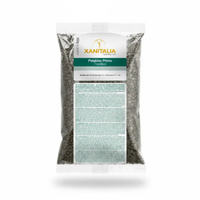
- XanitaliaPro Film Wax (1000 g): Film wax as black wax beads with carnauba wax, beeswax, and jojoba oil, no non-woven strips.
- Pelables Primo Brazilian System Film Wax (Mauve Jasmine): Stripless film wax with titanium dioxide, soft and elastic texture, and a jasmine scent.
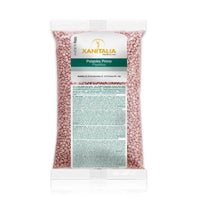
- Stripless Hard Wax Traditional System (Pink Titanium): traditional hard wax with titanium dioxide and good spreadability.
- Xanitalia Wax Beans: Stripless wax beads with low application temperature, available in black, vanilla, aloe vera, and jasmine variants.
Xanitalia itself distinguishes in its range between strip wax, film wax in the "Brazilian System," traditional hard wax, and sugar paste – a good orientation guide when comparing products.
Temperature and wax heater
Stripless wax is melted in a wax heater and brought to working temperature before application. The appropriate temperature is stated on the respective wax – for the Xanitalia Brazilian Hard Wax Aloe Vera, the product description mentions, for example, 38 to 40 °C. The 120 W wax heater with thermostat regulates, according to the description, in the range of approx. 35 to 120 °C, has a removable aluminum pot, and is suitable for hard, strip, and bead waxes.
Check the temperature before every application on a small area of skin, for example on the inside of the wrist. This allows you to see if the wax is pleasantly warm and not too hot.
Procedure and hygiene in the salon
- Clean the skin and prepare it so it is dry. Do not wax over irritated, injured, or inflamed skin.
- Check hair length: The wax must be able to grip the hair. Often, at least a few millimeters are recommended.
- Apply wax with a spatula in the direction of hair growth – thin for film wax, somewhat thicker for traditional hard wax.
- Let it harden, pull the skin taut, and pull off quickly against the direction of hair growth.
- Use a fresh disposable spatula for every application and never dip a used spatula back into the wax.
- Remove wax residues according to the manufacturer's instructions and nourish the skin afterward.
One or two wax systems?
Many salons work with two systems: a film or hard wax for underarms, the bikini area, and the face, and a second wax for large areas – either strip wax or a high-yield film wax. To ensure both waxes are ready for use at the same time, each requires its own pot or device. Those who have only a few waxing appointments can get by with a film wax that, according to the manufacturer, is suitable for the entire body.
Regarding quantity, a look at your appointment calendar helps: for salons with regular appointments, 1000 g tubs like those for XanitaliaPro Film Wax are worth it; disposable wooden spatulas are available in packs of 10 or 100. You can find waxes, equipment, and accessories collected in the Cosmetics & Waxing category.
Frequently asked questions
What is the difference between hard wax and film wax?
Both are removed without non-woven strips. Film wax contains elastic components, can be applied thinner, and remains more flexible when pulled off.
Are wax beads and stripless wax the same?
Mostly, yes: Wax beads are the bead form of hard or film wax. Whether a product is used without strips is stated in the product description.
Do I need a special device for wax beads?
You need a wax heater with a pot and thermostat in which the beads can melt. Cartridge warmers for roll-on wax are not intended for this.
Can I reuse leftover wax?
Wax that has already been on the skin should be discarded for hygienic reasons. Unused wax in the pot can be reheated according to the manufacturer's instructions.
Can I also use stripless wax for the legs?
Yes, film and hard waxes like those from Xanitalia are, according to the manufacturer, designed for full-body hair removal. On very large areas, strip wax is often faster.