Oxidizing agent 1.5–12%: Strength for hair color, toner, lightener
Von Hassieb Kalla · Dr.Kalla RedaktionShare
Rule of thumb for practice: Low strengths up to 3% are intended for tints and toners, 6% is the standard for coloration and grey coverage, 9% and 12% are used for stronger lightening and bleaching. However, the instructions for the color or bleaching agent always determine which strength you need in an individual case—not the rule of thumb.
We explain the basics of 3%, 6%, 9%, and 12% in the article Choosing the right developer. This article covers the entire spectrum from 1.5% to 12%, the conversion to Vol., and the handling of oxidizing agents in everyday salon life.
The table: Oxidizing agents from 1.5% to 12%
| Strength | Vol. | Typical application (reference value) | Practical note |
|---|---|---|---|
| 1.5% | 5 Vol. | Tints and gentle color changes without lightening | Often intended for tinting and glossing systems |
| 3% | 10 Vol. | Tone-on-tone, deepening color, darkening, and depending on the system, toners on pre-lightened hair | Provides little to no lightening |
| 4% or 4.5% | 13 or 15 Vol. | Intermediate level for individual color systems | Only use if specified by the color system |
| 6% | 20 Vol. | Permanent coloration and grey coverage, approx. 1–2 levels of lightening | The most frequently used strength in the salon |
| 9% | 30 Vol. | Lightening coloration with approx. 2–3 levels, bleaching, for example, in foil | Monitor processing time and hair condition carefully |
| 12% | 40 Vol. | High-lift colors and bleaching with strong lightening | Often only intended for use without scalp contact; highest concentration permitted for hair products in the EU |
These values are reference values based on product specifications and salon practice. They do not replace the instructions for use of the specific product.
Percent and Vol.: How these values are related
The percentage indicates the proportion of hydrogen peroxide. "Vol." stands for volume and describes how much oxygen the product can release: One liter of 3% hydrogen peroxide provides about 10 liters of oxygen, which is why 3% corresponds to about 10 Vol. As a rule of thumb: multiply the percentage by 3.3 to get approximately the Vol. number. Thus, 1.5% corresponds to about 5 Vol. and 4.5% to about 15 Vol.
The strength is legally capped at the top: The EU Cosmetics Regulation (EC) No. 1223/2009 allows a maximum of 12% hydrogen peroxide (40 Vol.) in hair products, either contained or released. Packaging must then include mandatory warnings such as "Contains hydrogen peroxide," "Avoid contact with eyes," and "Wear suitable gloves."
Which strength for color, toner, and bleach?
Coloration and grey coverage
For permanent colors, 6% is the standard for many systems; you use 3% more for tone-on-tone or darkening. This also applies to ammonia-free systems: KYO, for example, offers its creamy Bio-Activator as KYO Oxidant 6% (20 Vol.) as well as in 3%, 9%, and 12%.
Toners and tints
Toners and tints work with low strengths or with their own specific activator. For the semi-permanent KYO tint Majime, the product description mentions an oxidant with 2.5 or 5 Vol., depending on the desired result. For the Black Professional tints Platinum Ash and Platinum Pearl, there is a suitable tinting activator.
Bleaching
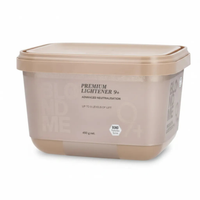
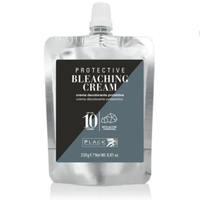
Bleaching powder and bleaching creams are usually mixed with 6%, 9%, or 12%, depending on the desired level of lightening. An example from product specifications: For FREELIMIX Blue Bleach, the manufacturer recommends 6% for 2–3 shades and 9% for 4–9 shades, each with different processing times. For work involving scalp contact, many manufacturers recommend lower strengths than for highlights in foil. You can read more about lightening in our guide Bleaching & Lightening.
Oxidizing agents in everyday salon life
- Stick to the system: Use color and oxidizing agent from the same line if the manufacturer specifies it—for example, the Igora Royal Oil Developer for IGORA ROYAL or Welloxon Perfect for Koleston Perfect. Do not combine brands without the manufacturer's approval.
- Measure accurately: Work with a scale or measuring cup to ensure the mixing ratio is correct. Guessing leads to inconsistent results.
- Choose appropriate sizes: For frequently used strengths, 1-liter bottles such as the Black Professional oxidizing agent in 1.5% to 12% are worth it. It is better to buy less frequently used strengths in smaller sizes, for example as a 250 ml oxidant in 6%, 9%, or 12%.
- Store properly: Close bottles immediately after use and store them as specified by the manufacturer—usually in a cool place protected from light. Do not save mixed leftovers.
- Label: If several mixtures are running in parallel, label the bowls with the strength and start time.
Safety applies to every strength
Hydrogen peroxide must not get into the eyes; in case of contact, rinse eyes immediately with water, as stated in the mandatory warnings. Gloves are essential when coloring, tinting, and bleaching—for hair salons, the TRGS 530 regulations mandate the use of disposable gloves when working with hair chemicals. For oxidative colors, an allergy test according to the manufacturer's instructions is also required, as hair dyes can cause allergic reactions.
Frequently asked questions
Is 6% oxidizing agent the same as 20 Vol. developer?
Yes. 6% hydrogen peroxide corresponds to 20 Vol. Oxidizing agent, oxidant, developer, and hydrogen are usually used interchangeably in the salon.
What do I need 12% developer for?
For high-lift colors and bleach with strong lightening—and only if the product instructions specify 12%. Stronger oxidizing agents are not permitted for hair products in the EU.
Can I save time by using a higher strength?
No. Percentage, mixing ratio, and processing time are coordinated with each other. Deviating from these risks uneven results and unnecessary stress on the hair and scalp.
Can I use hair developer for eyelashes and eyebrows?
No. There are specific products for this, such as the RefectoCil Oxidant Cream 3%. For the KYO oxidants with 6%, 9%, and 12%, for example, it is explicitly stated that they should not be used for tinting eyelashes or eyebrows.
You can find all strengths and container sizes in the Developer & Preparation category.